Module Four: Collection Assignment
For this assignment we had to pair up with a local public school library and make up a program for our proposed school.
I did my reading and activities on Filipino American History Month.
Florida K-12 Integrated Library Media Reading Guidelines
Read as a Personal Activity — Florida Standard 4.1.1.1: Choose age and ability appropriate literature to read based on interest or curriculum need.
Explore characteristics, history, and awards of creative works — Florida Standard 4.2.2.2: Recognize cultural and ethnic diversity through creative and literary works.
Analyze structure and aesthetic features of creative works — Florida Standard 4.3.1.3: Identify central ideas and supporting details of a work (e.g., paraphrasing, summarizing).
Develop a literary-based product — Florida Standard 4.4.1.1: Choose a method to present an original work or a response to a creative work from teacher or librarian choices.
Score reading progress — Florida Standard 4.5.1.1: Participate in school library activities and reading celebrations (e.g., family literacy night, author visits)
Since October is Filipino American History month, my curated collection will be five picture books for fourth grade readers of Booker Creek Elementary. Students will participate in read-alouds. For my virtual curated collection, author visits are YouTube vidoes of the author (though not all) reading his or her book. It is highly suggested that family be involved in Filipino American history month festivities for I have included links to resources to learn more about it. Students will participate by submitting drawings and artwork that coincides and illustrates their favorite book in the collection.
As the students read and engage, I will pass out these handouts that help them keep track of the books’ details.
The below forms are from Karpino Feed.
Students can fill out this book report form after reading their selected book.
Students can make learning fun reading like a detective by filling out this handout to assist with mapping out facts, plot and characters:
Where is the Philippines?
Filipino Friends by Liana Romulo & Illustrated by Corazon Dandan-Albano

“Travel to the Philippines without leaving home!
From the author of Filipino Children’s Favorite Stories comes a book for young children that features a Filipino-American boy visiting the Philippines for the very first time. Each watercolor illustration is labeled with English words and their Filipino translations and shows readers both the similarities and differences between Western and Philippine lifestyles. Filipino Friends, perfect for Filipino-American’s or those just interested in the culture, is indispensable in bridging the gap between the two cultures.
Following the sweet multicultural children’s story, kids will learn about Philippine customs and traditions, including:
- Filipino festivals and celebrations
- Traditional dress
- Snacks and meals
- Songs and games
- The Filipino language—Tagalog—and more!”
Cora Cooks Pancit by Dorina Lazo Gilmore & Illustrated by Kristi Valiant
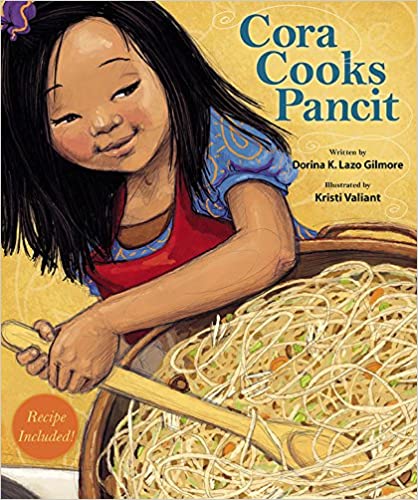
“Cora and Mama work together to cook up pancit for the family in this celebration of Filipino heritage and foods.
Cora loves being in the kitchen, but she always gets stuck doing the kid jobs like licking the spoon. One day, however, when her older sisters and brother head out, Cora finally gets the chance to be Mama’s assistant chef. And of all the delicious Filipino dishes that dance through Cora’s head, she and Mama decide to make pancit, her favorite noodle dish.
With Mama’s help, Cora does the grown-up jobs like shredding the chicken and soaking the noodles (perhaps Mama won’t notice if she takes a nibble of chicken or sloshes a little water on the floor). Cora even gets to stir the noodles in the pot-carefully– while Mama supervises. When dinner is finally served, her siblings find out that Cora did all their grown-up tasks, and Cora waits anxiously to see what everyone thinks of her cooking.
Dorina Lazo Gilmore’s text delightfully captures the warmth between mother and daughter as they share a piece of their Filipino heritage. With bright and charming illustrations by Kristi Valiant, Cora’s family comes alive as Cora herself becomes the family’s newest little chef.”
Hand Over Hand by Alma Fullerton & Illustrated by Renné Benoit

“Who says girls can’t fish?
When Nina asks her grandfather to take her fishing with him on his old banca boat, his answer is always the same: “A boat is not the place for a girl.”
But Nina is determined to go. She knows that if her lolo will show her how to jig the lines, to set the hook, and to pull in a fish, hand over hand, she can prove to everyone in their Filipino fishing village that she deserves her turn in the boat, girl or no!”
Is it a Mermaid? by Candy Gourlay & Illustrated by Francesca Chessa

“When Benji and Bel find a strange creature on a tropical beach they know it’s a Dugong. But the Dugong insists she is a beautiful mermaid and to prove it, she shows them a mermaid song.
The children aren’t convinced but they play with their new friend all the same. When it’s time for her to go back to sea, there is one surprise left – could she be a mermaid after all?
Conservation information about the Dugong is included at the back of the book.”
Lakas and the Manilatown Fish by Anthony Robles & Illustrations by Carl Angel
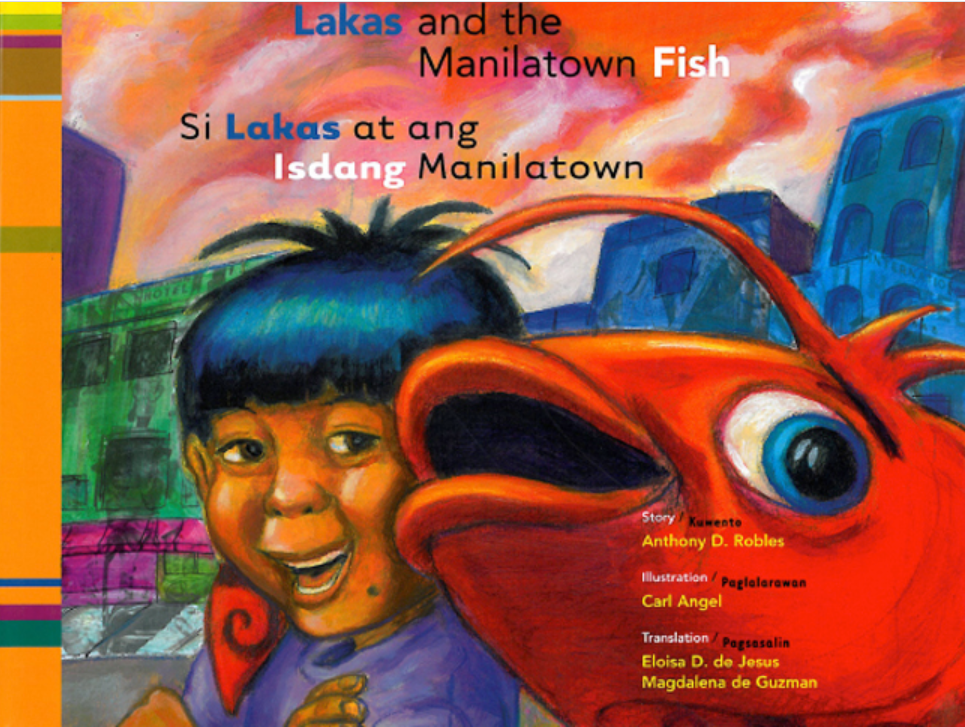
“Can a fish talk? Can it jump and play and run-especially run-just like a small boy? When Lakas and his dad go shopping, they meet a very special fish that can do all these things and more. This fish won’t stay put in his fish tank! Once it leaps out, a cast of unusual Manilatown characters chases it down Kearny Street and all the way to San Francisco Bay. Hoy, hoy! Will Lakas and his friends ever catch this sly and charming fish? Will Lakas’s dearest wish come true?
In this first-ever bilingual English-Tagalog story set in the U.S., an all-American boy of Filipino descent, some amusing manongs-Filipino elders-and a fish with unusual faculties take off on a fanciful romp through a dreamscape of the imagination. Author Anthony D. Robles’s irrepressibly lively characters and improbably funny adventure will delight readers. Artist Carl Angel’s evocative illustrations leap off the page and pay affectionate homage to one neighborhood’s Filipino-American past.”
Great resources:
- The Hawaii Book Blog is a great resource that gives the history of Filipino American culture:
- The below libguide helps adults learn more about Filipino American culture so they can in turn understand their children’s reading and follow what they are learning.
- Below is another great resource: “Korpino Feed is an Asian American lifestyle site. Our focus is to be an authentic representation of the Asian American Community”
- KidsKonnect is a great resource for teachers with lesson plans and handouts but requires a subscription fee:
- Below, is the Wikipedia page for a comprehensive quick facts about Filipino American History month.
- 15 FACTS – FILIPINO AMERICAN HISTORY | FIL-AM MONTH is a great video that shows the history of Filipino Americans and their contributions:
- Juju is a Filipino American girl who shares her personal story that other kids her age can relate to:
- Virtual celebration of Filipino American History Month by Mayor Landon Breed of San Francisco: October 21, 2020 @ 5:30 PST
- Santa Monica College’s Global Citizen page on Filipino American History month:
- Facebook page for Filipino American National Historical Society (FANHS)
“The Filipino American National Historical Society (FANHS) was founded in 1982. Its mission is to promote understanding, education, enlightenment, appreciation and enrichment through the identification, gathering, preservation and dissemination of the history and culture of Filipino Americans in the United States. FANHS is a volunteer-run organization with a National Office and National Pinoy Archives in Seattle, Washington, a National Museum in Stockton, California, and 38 Chapters across the United States.” https://www.facebook.com/FANHSnatl
- The official webpage of Filipino American National Historical Society (FANHS)
 By the Stacks