Goal I: Leadership and Innovation
Students are innovative, ethical problem-solvers able to lead and manage through communication.
Artifact #1
I.c. Students participate in professional and community engagement activities in the field.
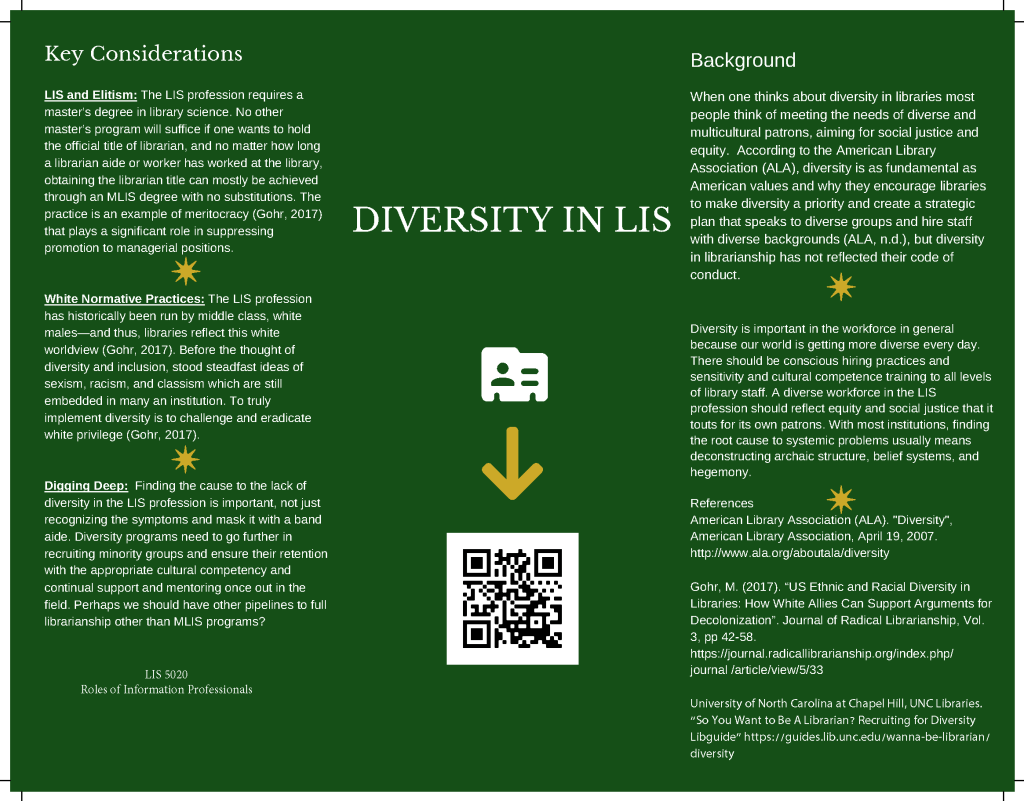
For this assignment we had to create an informational poster as if we were to submit it to a symposia. It helps us to put a presentation together to communicate our findings to the public.
This is an informational poster I created detailing the emerging roles of change management: Diversity in LIS.
Artifact #2
I.a. Students are able to evaluate critically, reflect, and problem-solve individually as well as collaboratively.
For this assignment, I continued on the theme of diversity or lack thereof in LIS. We had to create an Issue Briefing on the topic of choice which helps inform the above informational poster.
Issue Briefing
What Does Diversity in the LIS Profession Look Like?
Issue
Hiring practices in the LIS profession does not coincide with the diversity programs implemented in library programs to serve their diverse populations, and library management remain predominately white. The problem with this lack of representation is lodged way deeper than the current LIS diversity programs can reach.
Background
When one thinks about diversity in libraries most people think of meeting the needs of diverse and multicultural patrons, aiming for social justice and equity. Depending on the community the library serves, such as a library in an inner city versus one in the suburbs or in rural areas, the programs are geared to what the patrons’ needs and interests are. According to the American Library Association (ALA), diversity is as fundamental as American values and why they encourage libraries to make diversity a priority and create a strategic plan that speaks to diverse groups and hire staff with diverse backgrounds (ALA, n.d.), but diversity in librarianship has not reflected their code of conduct.
Current
University of North Carolina’s libraries created a Libguide on “So You Want to Be A Librarian? Recruiting for Diversity”, listing many library associations for underrepresented groups and the ALA’s take on Recruiting for Diversity (2020). In terms of diversity and inclusion, libraries have had a history of not hiring diverse staff even though they serve a diverse population, remaining “predominately white” (Larsen, 2017). Larsen goes on to say that the need for a diverse staff is to adequately serve a diverse population with a library staff from diverse backgrounds and it starts with the library’s hiring managers to improve hiring practices and training, which goes in line with Michelle Gohr’s statement that most library management are inherently white males (2017).
Perhaps the barrier to hiring diverse staff is that LIS coursework initiatives fail in recruiting and retaining diverse students to begin with. April Hathcock states that “diversity does not work because they are themselves coded to promote whiteness as the norm in the profession and unduly burden those individuals, they are most intended to help” (2017). It is white normativity that prevails within and throughout the LIS profession and LIS diversity programs that discourages minorities and diverse groups to stay.
Key Considerations
LIS Diversity Programs: The daunting application process for most graduate programs involve a lot of moving parts for one person to navigate such as providing all transcripts, test scores, letters of recommendation, and the LIS program is no exception (Hathcock, 2017). Not only recruiting minority groups is a problem but retaining them is worse because mentoring in the field is lacking.
White Normative Practices: The LIS profession has historically been run by middle class, white males— and thus, libraries reflect this white worldview (Gohr, 2017). Before the thought of diversity and inclusion, stood steadfast ideas of sexism, racism, and classism which are still embedded in many an institution. To truly implement diversity is to challenge and eradicate white privilege (Gohr, 2017).
LIS and Elitism: The LIS profession requires a master’s degree in library science. No other master’s program will suffice if one wants to hold the official title of librarian, and no matter how long a librarian aide or worker has worked at the library, obtaining the librarian title can mostly be achieved through an MLIS degree with no substitutions. The practice is an example of meritocracy (Gohr, 2017) that plays a significant role in suppressing promotion to managerial positions.
Digging Deep: Finding the cause to the lack of diversity in the LIS profession is important, not just recognizing the symptoms and mask it with a band aide. Diversity programs need to go further in recruiting minority groups and ensure their retention with the appropriate cultural competency and continual support and mentoring once out in the field. Perhaps we should have other pipelines to full librarianship other than MLIS programs?
Conclusion
Diversity is important in the workforce in general because our world is getting more diverse every day. A diverse workforce should reflect the population that it serves. There should be conscious hiring practices and sensitivity and cultural competence training to all levels of library staff. A diverse workforce in the LIS profession should reflect equity and social justice that it touts for its own patrons. With most institutions, finding the root cause to systemic problems usually means deconstructing archaic structure, belief systems, and hegemony.
Works Cited
American Library Association (ALA). “Diversity”, American Library Association, April 19, 2007.
http://www.ala.org/aboutala/diversity
Gohr, M. (2017). “US Ethnic and Racial Diversity in Libraries: How White Allies Can Support Arguments for Decolonization”. Journal of Radical Librarianship, Vol. 3, pp 42-58. https://journal.radicallibrarianship.org/index.php/journal/article/view/5/33
Hathcock, A. (2015, October 7). “White Librarianship in Blackface: Diversity Initiatives in LIS”. In the Library with a Lead Pipe. http://www.inthelibrarywiththeleadpipe.org/2015/lis-diversity/
Larsen, S. (2017, December 7). “Diversity in Public Libraries Strategies for Achieving a More Representative Workforce.” Public Libraries Online. http://publiclibrariesonline.org/2017/12/diversity-in-public-libraries-strategies-for-achieving-a-more-representative-workforce/
University of North Carolina at Chapel Hill, UNC Libraries. “So You Want to Be A Librarian? Recruiting for Diversity Libguide” https://guides.lib.unc.edu/wanna-be-librarian/diversity
Artifact #3
I.d. Students demonstrate leadership skills and innovation in a diverse and global environment.
This assignment demonstrates my understanding of the functions that enact the values and ethics associated with the profession. I decided to focus on New Haven Free Public Library’s website to detail how they reflect various professional values.
Connecting Services to Values, Part II
New Haven Free Public Library’s front page is welcoming and informative, reflective of the diverse community it serves because it lists categories in boxes with appealing images such as “Books for Young Minds,” “Our Stories, “Cultural Connections”, and “Readmobile,” to name a few. The photos that reflect the people that it serves shows that the library is in touch with the community and this connects to the ALA principle of “Diversity (Old Number 60),” which states that, “ALA promotes equal access to information for all persons and recognizes the ongoing need to increase awareness of and responsiveness to the communities we serve.” These photos and the services offered are found by clicking on the links on the New Free Haven Public Library’s website which satisfies ALA’s values and policy objectives. The images and the connecting links display how “libraries can and should play a crucial role in empowering diverse populations for full participation in a democratic society.”
The categories on the website focuses the materials and the services they decided to focus and curate. However, digging deeper it is evident that the value that they meet is evident in the outreach they implemented to bridge local organizations and the libraries to work symbiotically to enrich the community. At first glance, one might think that the website is overly simplified and may think that it is basic. However, the jewel of their services can be found under various menus such as “Services”, “Spaces”, and “Collections”. It is a shame, however, that the spirit and vibrant community is not really felt through the NHFPL’s website design. Furthermore, I found out the wonderful things that NHFLP has done through an article I found that the librarians from this public library won the 2019 National Medal for Museum and Library Service for their exceptional contributions to their communities.
The services and programming NHLFP offer are meaningful and enriching and given the issues of institutional racism being at the forefront of many discussions these days, the meaningful programs are much needed. By giving access to the local theater group to library and city residents for free addresses ALA’s “Goals for Inclusive and Culturally Library and Information Services (Old Number 60.4).” As I stated, NHFPL’s website is not reflective of the all the true efforts the library made to ensure diversity, but the pictures do reflect diversity.
It is evident that the focus of the library is the community outreach that draws its patrons in to utilize all the wonderful services and programming it offers by selecting community ambassadors that interface with their segment of the community and help stay connected with the library. The programming itself is composed of technology training, opportunities to share and embrace cultural heritage, be the catalyst for the intersection of arts and the library, and of course, providing the diverse reading materials, such as books, eBooks, DVDs, etc. What was most inspiring were the videos I found that really describe the library’s unique approach to community outreach, particularly the one entitled “My NHFPL Story: Community Ambassadors.
This video explains how the library offers speaking platforms for its patrons to share their stories and cultural heritage. Because of the diversity in its programming, this brings the community into the library, thus making it vibrant and robust. It is not surprising either that they had garnered such a prestigious award. Lastly, ALA states “the creation of library services and delivery operations, which will ensure rapid access to information in a manner reflective of the communities they serve” and New Haven Free Public Library lives up to that and through it’s own name “free”.
Works Cited
American Library Association. (August 4, 2010). B.3 Diversity (Old Number 60), http://www.ala.org/aboutala/governance/policymanual/updatedpolicymanual/section2/3diversity
American Library Association. (2003-2004). Core Values Task Force II Report. http://www.ala.org/aboutala/sites/ala.org.aboutala/files/content/governance/policymanual/updatedpolicymanual/ocrpdfofprm/40-1corevalues.pdf
American Library Association (July 26, 2020) Core Values of Librarianship. http://www.ala.org/advocacy/intfreedom/corevalues
New Haven Free Public Library (n.d.) https://nhfpl.org/
Artifact #4
I.b. Students demonstrate effective communication skills
We had to briefly identify and describe a trend we chose and explain why this trend is important and how it might affect LIS services, resources, collections and practice.
My video presentation focuses on library trends that serve the aging population. I am interested in in the diverse programs and services libraries serve within their communities, and being in Florida, I wanted to see how others are servicing and doing the community outreach to the older population. Technology can be used for seniors too, whether training them on a new app or assist them on how to navigated the internet, the usual tech trends for teens can also be applied to seniors. I hope you all take a look at how many libraries are coming up with inventive and exciting programs for our older population.
Note: You will have to turn your audio up to hear. The volume was recorded too low for my liking!
Library Trends
Artifact #5
Lastly, this assignment illustrates the varied skills and experiences of librarians. Creating a two-three minute elevator speech why information and library science degree is important was fun but not as easy as I thought as I had to succinctly give the reasons why. I drew from my personal experiences and goals and communicated how American Library Association values and goals are in line with mine.
 By the Stacks